


Table of Contents
- Why Buying From Independent Makers Is Worth the Extra Cost
- Handmade vs Mass-Produced Products: What Actually Changes
- How to Identify Handmade Products Before You Buy
- The Ethical Benefits of Buying Handmade: Direct Sales and Fair Pay
- Sustainable Handmade Products: What the Evidence Shows
- Strengthening Local Economies and Creative Livelihoods
- Practical Buying Considerations: Pricing, Returns, and Finding Makers
- Conclusion: Choosing Pieces That Earn Their Place
- Frequently Asked Questions
Last Updated: October 6, 2026
Why Buying From Independent Makers Is Worth the Extra Cost
The benefits of buying from independent makers start with a simple shift in where your money lands. At Moss and Fog Shop, we hold every piece in our own inventory so we can check the work before it reaches you, and that closeness to the source is exactly what makes this kind of shopping different.
Here is what most buying guides get wrong: they treat handmade as a mood, when it is really a supply chain.
That difference shows up in three places: how it is made, who gets paid, and how long it lasts.
Below, we break down what actually changes when you buy direct, how to spot genuine handmade goods, and what to check before you order.

Handmade vs Mass-Produced Products: What Actually Changes
Handmade vs mass-produced products differ in three concrete ways: production volume, who keeps the profit, and how much variation you should expect. Mass-produced goods are identical by design; handmade goods carry small irregularities that signal a human made them.
Small-Batch Production and Limited Runs
Small-batch production means a maker produces a set number of pieces at a time, often because a single person or a very small studio does the work. That constraint is the point.
You will notice it in the details. Edges get sanded by hand until they soften. A glaze behaves differently on each piece. No two items are quite the same, and that is a feature, not a defect.
Where the Money Goes: Maker Income and Fair Compensation
Direct sales change the math on maker income. When a maker sells through their own shop or a small curated retailer, they avoid the wholesale discount and the retailer's markup that eat into profit margins.
Mass-produced goods spread a small margin across enormous volume. Independent makers work the other way: fewer units, higher value per unit, and a living wage built into the price.
How to Identify Handmade Products Before You Buy
You can identify handmade products by reading the production process, checking the materials, and verifying the maker. If a listing cannot tell you who made the item and how, that is your answer.
Reading the Production Process and Materials
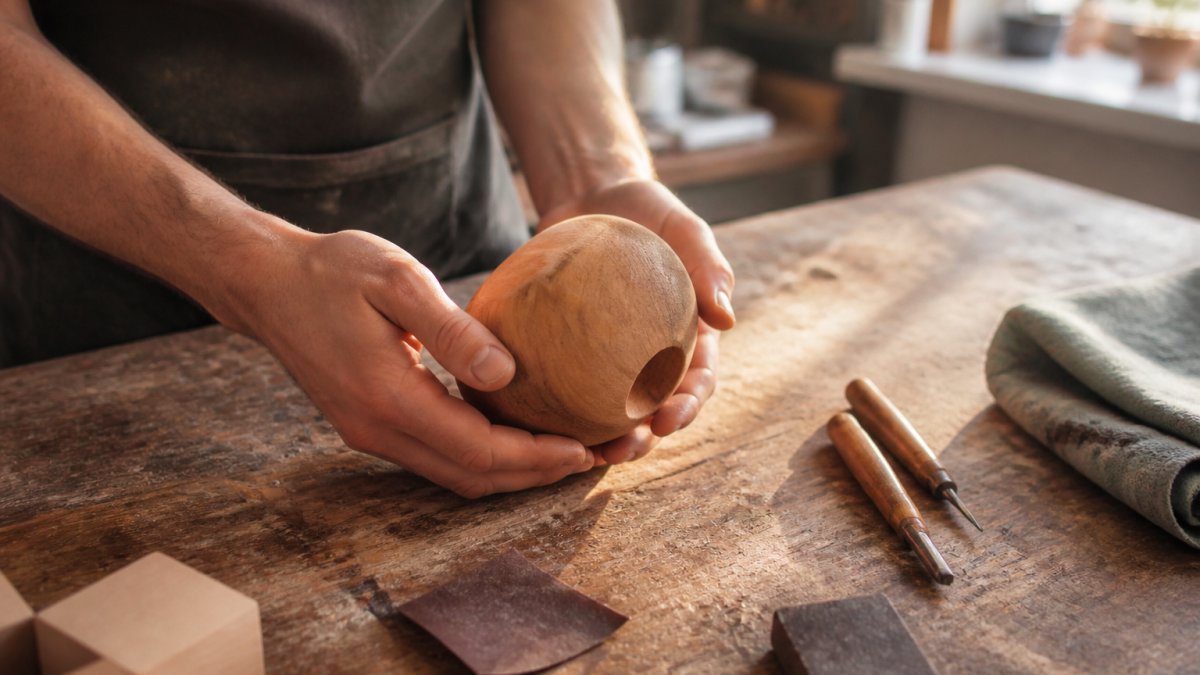
Look for language that describes a method, not a mood. "Hand-poured," "hand-cut," "hand-sanded," and "finished with natural wax" tell you a person touched the object. "Artisanal-inspired" tells you nothing.
Materials matter just as much. A maker who names the wood, the plant-based oils, or the glass is telling you what you are paying for.
Verifying the Maker Behind the Product Story
A product story is only useful if it names a real studio and a real process. Check for a maker name, a location, and a founding date. A studio that has been working since a specific year, with a stated method, is far harder to fake than a paragraph of atmosphere.
The Ethical Benefits of Buying Handmade: Direct Sales and Fair Pay
The ethical benefits of buying handmade come down to transparency.
When you buy direct, you are not guessing at a supply chain that spans continents. You are buying from a named studio with a visible production process.
It also changes the maker's side of the equation. A maker who sells directly keeps more of each sale, which funds the next run, better materials, and the time to refine a design.
Sustainable Handmade Products: What the Evidence Shows
Sustainable handmade products are not automatically greener than factory goods, and the honest answer is that the environmental case depends on four variables you can actually ask about: material sourcing, production scale, packaging, and shipping distance.
Here is where handmade and small-batch production tend to have a real edge, and where they do not.
Terrazzo Gem Soap, Full Size →
Where the advantage is real
- Overstock and deadstock. Mass retail is built around forecasting demand, and forecasts miss. Unsold inventory gets marked down, liquidated, or destroyed. A maker working in limited runs produces closer to actual demand, so fewer finished goods are warehoused and discarded. This is a structural difference, not a marketing one.
- Durability as a substitute for volume. A piece that stays in use for a decade replaces several shorter-lived replacements. The environmental benefit is not in the object itself but in the purchases it prevents. This is why repairability and material quality matter more than the word "handmade."
- Repair and refinish pathways. Many independent makers will refinish, re-glaze, or repair their own work, or tell you how to. That extends product life in a way a mass retailer rarely supports after the return window closes.
Where the caveat matters
- Shipping distance can outweigh production gains. A small-batch item shipped across the country or overseas carries a freight footprint that a locally made equivalent does not. Buying from a maker in your region is usually the higher-impact choice when the product categories are otherwise comparable.
- Material choice dominates. A hand-poured item made with a petroleum-derived resin is not environmentally preferable to a mass-produced item made from a recycled or rapidly renewable material. Ask what the piece is made from before you ask how it was made.
- Small-batch is not the same as low-waste. A single maker using a home studio may generate less industrial waste but also lacks the filtration, reclaim, and material-recovery systems a larger facility can afford. Scale cuts both ways.
Questions that get you a real answer
- What is this made from, specifically?
- Where does the material come from?
- How is it packaged and shipped?
- Can it be repaired or refinished, and by whom?
- How long is it expected to last with normal use?
A maker who can answer these in plain language is giving you more environmental information than any "eco-friendly" badge. A listing that cannot answer them is asking you to take sustainability on faith.
Strengthening Local Economies and Creative Livelihoods
Money spent with independent makers tends to stay closer to the point of sale. A studio that sells directly pays for materials, tools, workspace, and often local shipping out of the same revenue, so a larger share recirculates in the region where the work is made rather than routing through a national distribution chain.
What actually changes when you buy direct
- Fewer intermediaries take a cut. A wholesale arrangement typically requires the maker to sell at a discount to a retailer, who then marks the item up. Direct sales collapse those layers, which is why the same object can cost less direct from the maker than through a boutique, and why the maker can still net more.
- Repeat buyers replace ad budgets. Independent makers generally cannot outspend national brands on advertising. They depend on word of mouth, returning customers, and small curated retailers. Your repeat purchase is functionally their marketing budget.
- Revenue funds the next run. For a solo maker, cash flow is the constraint. A sale funds materials for the next batch, a tool upgrade, or the time to refine a design. This is why buying from a maker early in a product's life has an outsized effect.
The limitations worth naming
Independent makers are not the right answer for every purchase, and pretending otherwise makes the case weaker, not stronger.
- Availability and capacity. A single maker or small studio can only produce so much. Popular items sell out, restocks take weeks, and made-to-order timelines can run longer than a mass retailer's. If you need something by a specific date, confirm lead time before you order.
- Affordability. Handmade goods carry real labor costs, and not every budget can absorb them. There is no shame in buying mass-produced for some categories and independent for others. The goal is intentional spending, not guilt.
- Category limits. Independent makers are strong in home goods, apparel, jewelry, art, and small-batch food. They are rarely competitive in electronics, appliances, or anything requiring industrial tooling. Knowing where the model works keeps expectations realistic.
How to make the local purchase count

- Buy from makers in your region when the product category allows it.
- Prioritize pieces you will keep and use, not impulse buys.
- Ask about lead times and return terms before you commit.
- Leave a review or tell someone, for a small studio, that is the distribution channel.
Practical Buying Considerations: Pricing, Returns, and Finding Makers
Pricing, returns, and verification are the three things to settle before you order from any independent maker. Handmade goods cost more because the labor is real, so the value question is about durability and fit, not just price.
The table below covers the most common buying concerns and how to handle each one.
Concern |
What to Check |
Why It Matters |
|---|---|---|
Price seems high |
Materials named, hours of handwork described |
You are paying for labor and quality, not markup |
Is it truly handmade? |
Maker name, studio location, production method |
Verifies origin and rules out dropshipping |
Return policy |
Written terms before checkout |
Protects you on items you cannot see in person |
Shipping speed |
Whether stock is held or made to order |
Sets realistic delivery expectations |
Customization |
Whether the maker takes requests |
Confirms a direct relationship is possible |
What to Check Before You Order
- The listing names the maker or studio
- Materials and finish are specified
- The return window is stated clearly
Conclusion: Choosing Pieces That Earn Their Place
The real test of any purchase is whether the object earns its place in your home a year from now.
If you want that without hunting through scattered maker pages, Moss and Fog Shop curates handmade home goods, outdoor gear, apparel, and art prints from independent makers, all held in our inventory and packed in our studio.
Add to cart and bring home something made by a person, not a production line.
Frequently Asked Questions
What are the benefits of buying from independent makers?
You get a direct relationship with the person who made the piece, which usually means better material transparency and a real answer when you ask how something was produced. Buying from independent makers also keeps more of each sale with the maker instead of splitting it across wholesale, retail markup, and overhead. In practice that shows up as unique pieces, small-batch runs, and customization that mass-produced products cannot offer.
How can you tell if a product is genuinely handmade?
Look for variation between units, since hand-cut and hand-finished items rarely repeat exactly. A maker who names the studio, the materials, and the process is easier to verify than one who only uses the word artisanal. Ask what part is done by hand and what is machined. Many small studios machine rough shapes and then hand-sand every contour, which is still handcrafted work, and honest makers will tell you which is which.
Why are handmade goods often more expensive than mass-produced products?
A hand-cut bar of soap or a hand-sanded wooden sculpture carries labor that a factory line spreads across thousands of units. Small-batch production also means higher material costs per piece, limited runs, and no volume discount. That price difference is largely fair compensation for time and skill rather than a markup. You are paying for attention to detail and a shorter supply chain, not for a label.
Do independent makers use sustainable materials?
It varies by maker, so check the specifics rather than the general claim. Many small studios work with plant-based oils and butters, natural wax finishes, or solid hardwoods sourced in smaller quantities, which reduces waste from unsold inventory. Sustainable handmade products are not automatically better on every measure, since small studios may lack the recycling infrastructure of a large manufacturer. Ask what the material is and where it came from.